


Challenge
Three sites, three islands of IT.
The organization operated from three separate facilities in the same city. Each building had evolved independently — isolated IT environments with their own management, duplicated services, fragmented security, and little resource sharing. The result was higher complexity, less cross-site visibility, and added administrative overhead.
Key challenges
- Three independently managed IT infrastructures
- Duplicated services and administrative effort
- Inconsistent security policies
- Limited inter-site bandwidth
- Separate server and storage resources
- No centralized monitoring and management
- Future scalability limitations
Each site ran on separate internet connections. Even with two ISPs per location, a full outage at a site could still disrupt local operations, communications, and access to centralized services. The business needed an architecture that stayed connected even through multiple ISP failures.
Solution
A dark-fiber backbone tying the campus together.
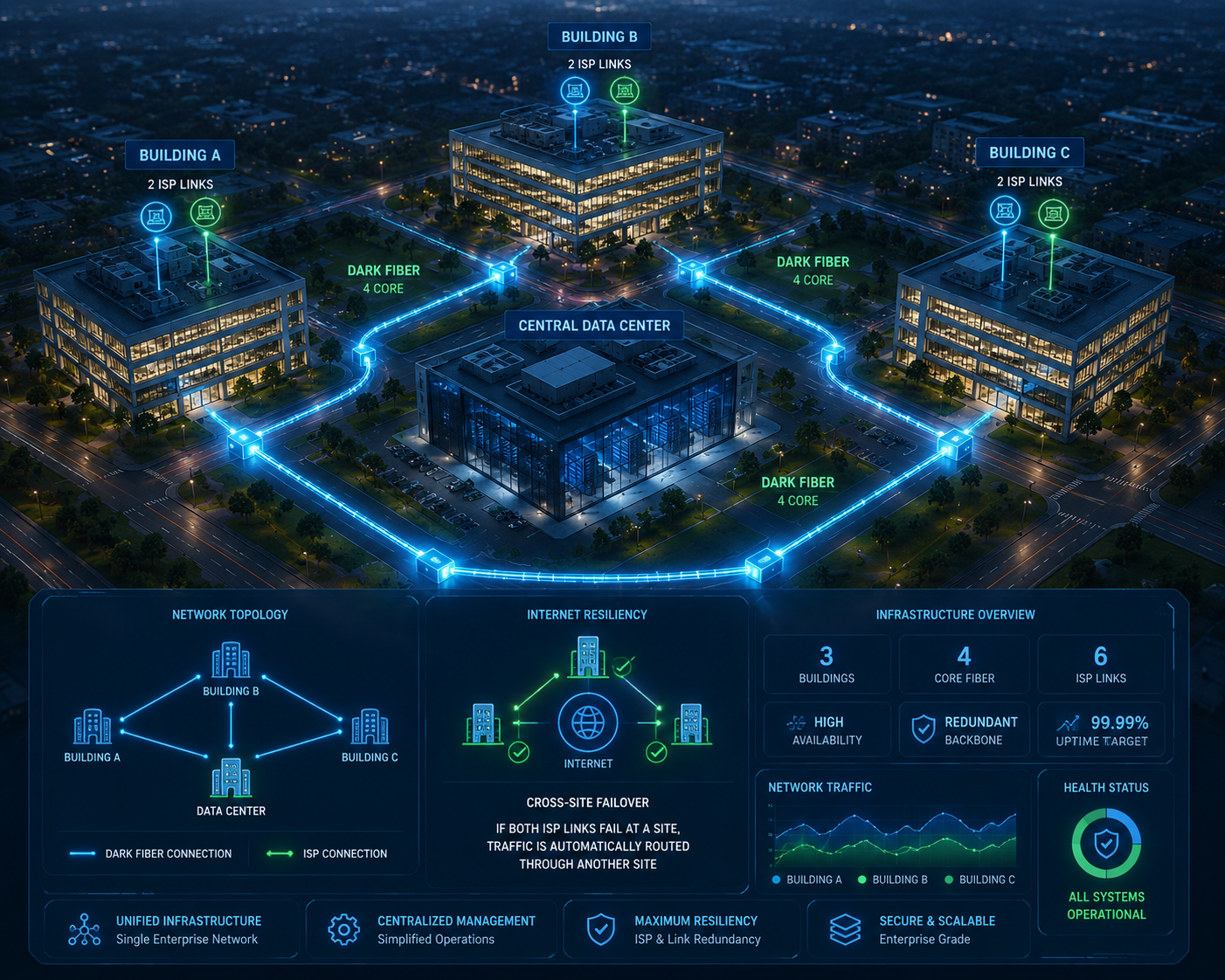
Designed and implemented a dedicated dark fiber backbone connecting all three facilities into one unified enterprise network — high-speed, low-latency links between buildings that enabled centralized infrastructure services and consolidated IT resources.
The project included
- Dark fiber deployment between facilities
- Redundant network architecture design
- VLAN segmentation
- Centralized authentication services
- Shared storage and virtualization platforms
- Unified monitoring and security controls
- Standardized network management
By integrating routing and failover across the fiber-connected sites, internet traffic could automatically reroute through another building whenever local providers went down — so losing both ISPs at one site no longer caused an outage. After implementation, all facilities operated as a single enterprise environment while keeping logical separation where needed.
Results
A unified, resilient backbone.
- Each building retained dual-ISP connectivity
- All three sites shared internet resources over the fiber backbone
- Losing both ISPs at one site no longer caused an outage
- Access stayed available via surviving providers at neighboring sites
- Critical operations continued without manual intervention
Technical specifications
Backbone, network and resiliency.
Backbone & connectivity
- Dedicated dark fiber between three facilities
- 4-core fiber backbone
- High-speed, low-latency inter-site links
- Redundant site-to-site connectivity
Network architecture
- VLAN segmentation
- Layer 3 routing across sites
- Centralized authentication services
- Shared storage and virtualization platforms
- Standardized network management
Internet & resiliency
- Dual ISPs per building (6 providers total)
- Three internet egress points
- Cross-site internet failover
- Automatic rerouting on local ISP loss
- Single point of failure eliminated
Operations
- Unified monitoring and security controls
- Centralized infrastructure services
- Consolidated IT resources across sites