


Challenge
Standalone workstations, manual accounts, no central control.
The organization relied on standalone workstations and manually managed user accounts — leading to inconsistent access controls, limited visibility into permissions, and heavy administrative overhead. Password policies weren’t standardized, onboarding and offboarding were manual, and there was no central platform for managing users, devices, or security settings.
Key challenges
- No centralized user authentication
- Inconsistent password and security policies
- Manual account creation and removal
- No role-based access controls
- Limited visibility into endpoint inventory
- Increased risk of unauthorized access
- Time-consuming workstation configuration
Solution
A centralized Active Directory identity platform.
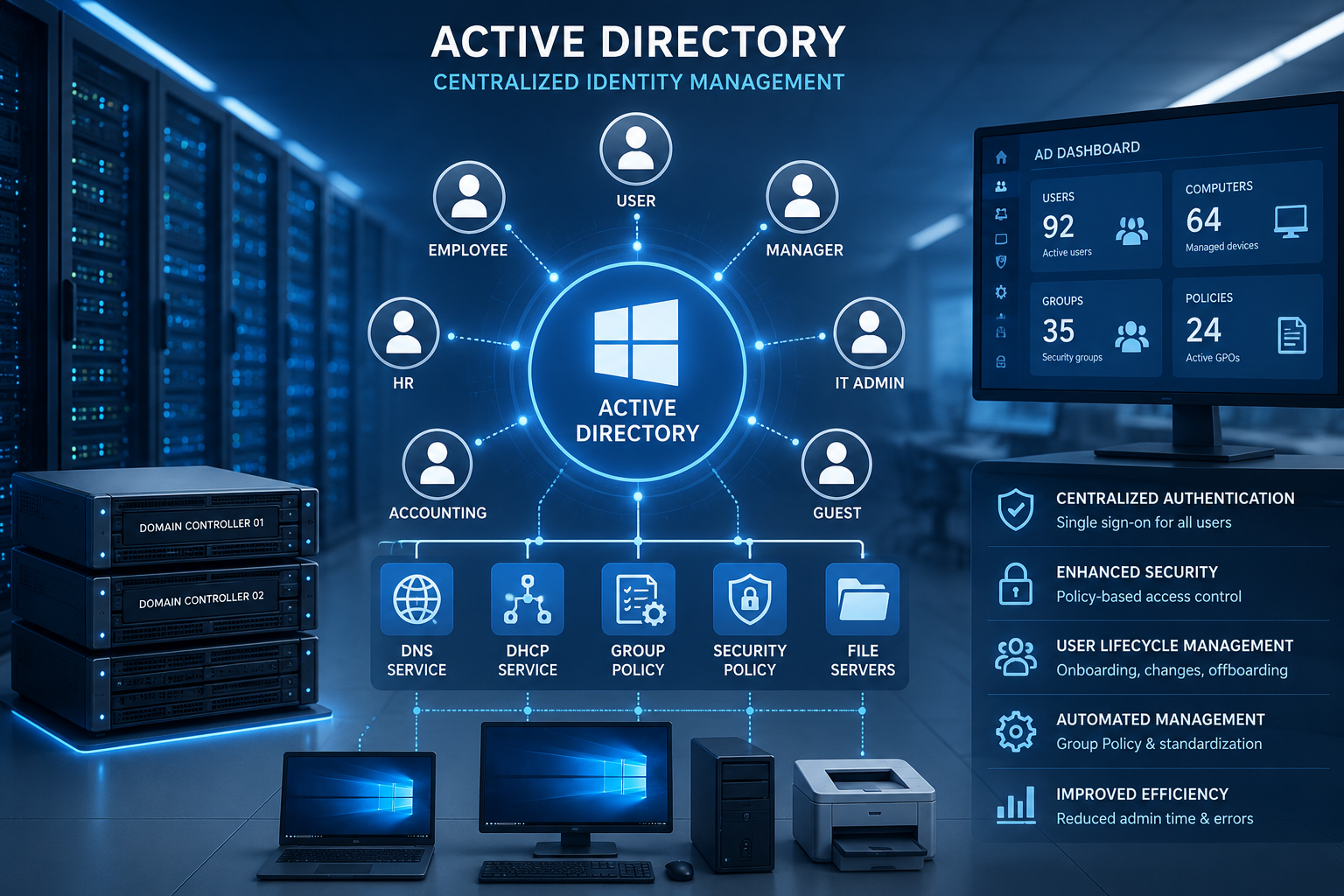
Designed and implemented a centralized Microsoft Active Directory infrastructure to standardize identity management across the organization.
The project deployed domain controllers; joined user workstations and servers to the domain; and built organizational units (OUs), role-based security groups, and Group Policy Objects (GPOs) to automate security and workstation configuration.
Further improvements included centralized DNS and DHCP, standardized onboarding, delegated administrative roles, and stronger security through policy enforcement. Implementation completed with minimal disruption while migrating existing users and systems into the new domain.
Results
Centralized identity, consistent control.
- Centralized authentication across the organization
- Standardized password and security policies
- Automated user provisioning and deprovisioning
- Role-based access enforced through security groups
- Consistent workstation configuration via Group Policy
- Improved visibility into users, devices, and assets
- Reduced administrative overhead and onboarding time
- Lower risk of unauthorized access
Technical specifications
What was put in place.
Core infrastructure
- Microsoft Active Directory Domain Services
- Windows Server 2019 / 2022
- DNS integration
- DHCP services
- Organizational Units (OU)
Identity management
- Centralized authentication
- Role-based access control (RBAC)
- Security groups
- User lifecycle management
- Delegated administration
Security controls
- Group Policy management
- Password complexity enforcement
- Account lockout policies
- Device restrictions
- Security baselines
Endpoint integration
- Windows workstations
- File servers
- Print servers
- Application servers
Operational improvements
- Automated user provisioning
- Standardized workstation configuration
- Centralized asset visibility
- Reduced administrative overhead